
History of the Workers Movement: Germany 1919: Could the revolution have won?
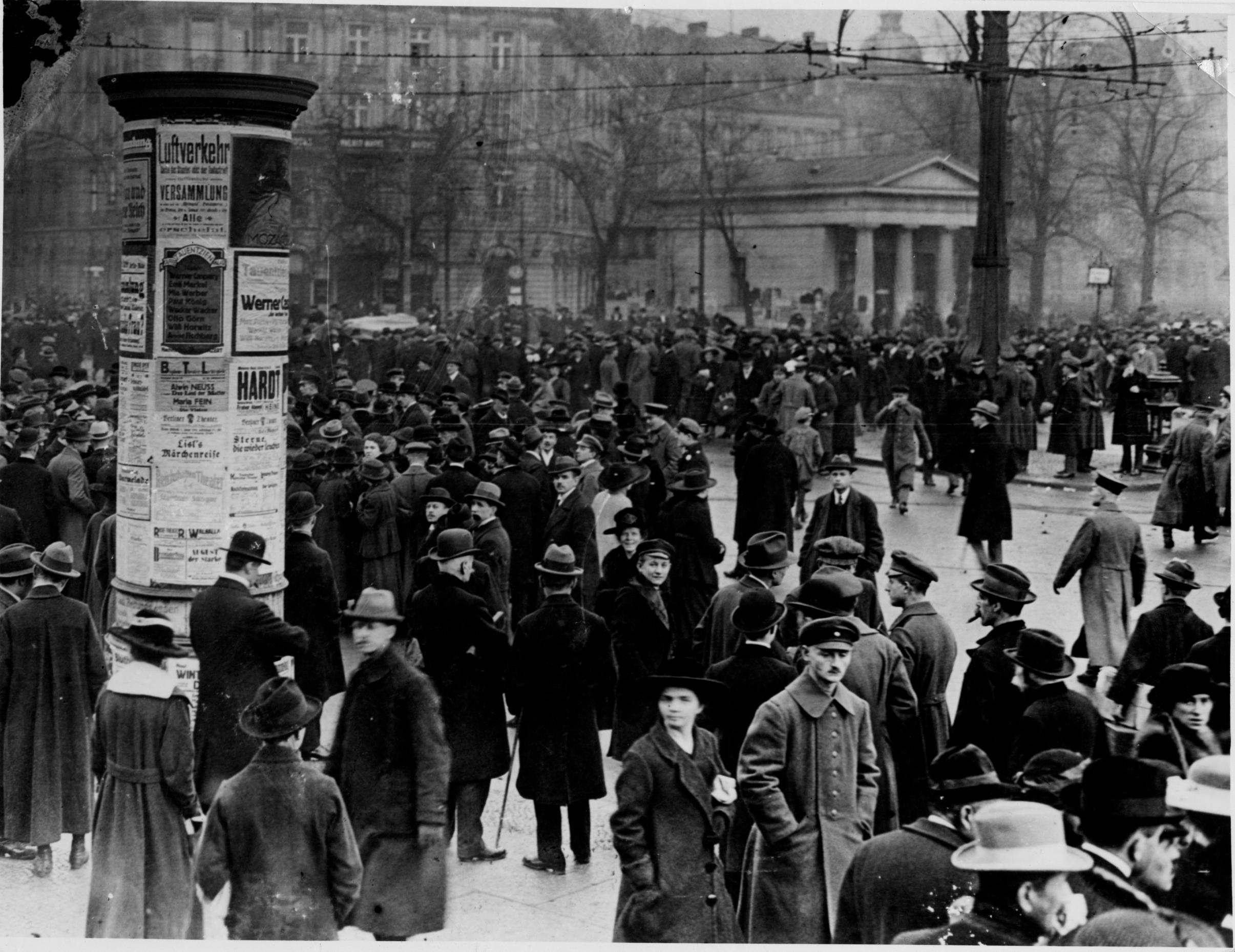
Germany 1918-19 (iv): Civil War
In the first three parts of our series on the German Revolution of
1918-19 we showed how, after the collapse of the Socialist International faced
with World War I, the tide turned in favour of the proletariat, culminating in
the November Revolution of 1918, which, like the October Revolution in Russia
the previous year, was the high point of an uprising against the imperialist
war. Whereas October represented the first mighty blow of the working class against
the "Great War", it was the action of the German proletariat which finally
brought it to an end.
Germany 1918-19 (iii): Formation of the party, absence of the International
When World War I broke out, the socialists met on 4th August 1914 to engage the struggle for internationalism and against the war: there were seven of them in Rosa Luxemburg's apartment. This reminiscence, which reminds us that the ability to swim against the current is one of the most important of revolutionary qualities, should not lead us to conclude that the role of the proletarian party was peripheral to the events which shook the world at that time...
Germany 1918-19 (i): Faced with the war, the revolutionary proletariat renews its internationalist principles
It is 90 years since the proletarian revolution reached its tragic culmination point with the struggles of 1918 and 1919 in Germany. After the heroic seizure of power by the Russian proletariat in October 1917, the central battlefield of the world revolution shifted to Germany. There, the decisive struggle was waged and lost. The world bourgeoisie has always wanted to sink these events into historical oblivion. To the extent that it cannot deny that struggles took place, it pretends that they only aimed at "peace" and "democracy" - at the blissful conditions presently reigning in capitalist Germany. The goal of the series of articles we are beginning here is to show that the revolutionary movement in Germany brought the bourgeoisie in the central country of European capitalism close to the brink of the loss of its class rule. Despite its defeat, the revolution in Germany, like that in Russia, is an encouragement to us today. It reminds us that it is not only necessary but possible to topple the rule of world capitalism.
1918: The revolution criticises its errors, Part 1
Faced
with all the conflicting arguments about the Russian revolution, it is
difficult to steer an even course between the predominant view - that the
revolution was a total disaster for humanity and inexorably led to the horrors
of Stalinism - and the less fashionable but equally uncritical portrayals of
Lenin and the Bolsheviks as superheroes who never made any errors...
Decadence of capitalism (i): Revolution has been necessary and possible for a century
In 1915, as the hideous reality of the European war became ever more apparent, Rosa Luxemburg wrote "The crisis of social democracy", a text better known as the "Junius pamphlet" from the pseudonym under which Luxemburg published it. The pamphlet was written in prison and was distributed illegally by the Internationale group which had been formed immediately after the outbreak of the war...
1918: the revolution criticises its errors
Marxism is first and foremost a critical method, since it is the product of a class which can only emancipate itself through the ruthless criticism of all existing conditions. A revolutionary organisation that fails to criticise its errors, to learn from its mistakes, inevitably exposes itself to the conservative and reactionary influences of the dominant ideology. And this is all the more true at a time of revolution, which by its very nature has to break new ground, enter an unknown landscape with little more than a compass of general principles to find its way. As we shall see, one of the consequences of the Bolshevik party identifying itself with the Soviet state was that it increasingly lost this capacity to criticise itself and the general course of the revolution. But as long as it remained a proletarian party it continuously generated minorities who did continue to carry out this task.
1905: the mass strike opens the door to the proletarian revolution
From the beginning of the first series of these articles, we argued against the cliché that 'communism is a nice idea, but it could never work' by affirming, with Marx, that communism is not at all reducible to a 'nice idea', but is organically contained in the class struggle of the proletariat. Communism is not an abstract utopia dreamed up by a few well-intentioned visionaries; it is a movement given birth by the very conditions of present day society. And yet, that first series was very much a study of the 'ideas' of communists during the ascendant period of capitalism - an examination of how their conception of the future society and the way to achieve it developed during the course of the 19th century, before the communist revolution was on the immediate historical agenda.
The Revolutionary Perspective Obscured by Parliamentary Illusions
At the end of the last article in this series, we looked at the principle danger posed to the social democratic parties operating at the zenith of capitalism’s historical development: the divorce between the fight for immediate reforms and the overall goal of communism. The growing success of these parties both in winning ever increasing numbers of workers to their cause, and in extracting concessions from the bourgeoisie through the parliamentary and trade union struggles, was accompanied, and indeed partly contributed to, the development of the ideologies of reformism...