
Skip to header Skip to main navigation Skip to main content Skip to footer
englishfrançaisdeutschitalianosvenskaespañoltürkçenederlandsportuguêsΕλληνικά
русскийहिन्दीفارسی한국어日本語filipino中文বাংলাmagyarsuomi
Home
International Communist Current
Workers of the world, unite!

Main navigation

      • Britain
      • India
      • United States
      • Rest of the world
    • By post
  • What is the ICC?
    • Introduction
    • Basic Positions
    • Platform
    • Manifesto (1975)
    • Manifesto (1991)
    • History of the ICC
      • 20 years of the ICC
      • 30 years of the ICC
    • What is the communist left?
    • ICConline
      • 1990s
      • 2000s
      • 2010s
      • 2020s
    • International Review
      • 1970s - 1 to 19
      • 1980s - 20 to 59
      • 1990s - 60 to 99
      • 2000s - 100 to 139
      • 2010s - 140 to 163
      • 2020s - 164 to ...
    • World Revolution
      • 1970s
      • 1990s
      • 2000s - 231 to 330
      • 2010s - 331 to 384
      • 2020s - 385 to ...
    • Internationalism
      • 1990s
      • 2000s
      • 2010s
    • Internasyonalismo
      • 2000s
      • 2010s
    • Communist Internationalist
      • 2000s
      • 2010s
    • Dutch and German Communist Left
    • The Italian Communist Left 1926-45
    • Communist Organisations and Class Consciousness
    • Nation or Class?
    • The Period of Transition
    • Decadence of Capitalism
    • Unions Against the Working Class
    • Left Wing of the Turkish Communist Party
    • Manifesto on the October revolution
    • World War I
    • Subscriptions
    • Buy from ICC
    • Buy offline

Rosa Luxemburg

Breadcrumb

  • Home

Rosa Luxemburg: the Bolsheviks represent the honor of the revolution

“During the lifetime of great revolutionaries, the oppressing classes constantly hounded them, received their theories with the most savage malice, the most furious hatred and the most unscrupulous campaigns of lies and slander. After their death, attempts are made to convert them into harmless icons, to canonize them, so to say, and to hallow their names to a certain extent for the “consolation” of the oppressed classes and with the object of duping the latter, while at the same time robbing the revolutionary theory of its substance, blunting its revolutionary edge and vulgarizing it.” (Lenin).

Of no revolutionary has this been more true than of Rosa Luxemburg. The heirs of her assassins – the social-democrats of every hue – would like to turn her into an icon of democracy against the dictatorial Bolsheviks. This, the first chapter of her work on the Russian Revolution, is a scathing rebuttal to such attempts to rewrite history: as she says in her conclusion, "All the revolutionary honor and capacity which western Social-Democracy lacked was represented by the Bolsheviks"

  • Read more about Rosa Luxemburg: the Bolsheviks represent the honor of the revolution

Introduction to the Korean edition of Rosa Luxemburg’s The Crisis in German Social Democracy (the “Junius Pamphlet”)

The ICC has contributed to the first Korean edition of Rosa Luxemburg’s Junius Pamphlet, written 100 years ago in response to the carnage of the First World War. We are publishing the introduction written for the new edition here. In its 100 year ‘commemorations’ of the war, the ruling class and its propaganda machine offers us so many forms of apology for the massacre; revolutionaries on the other hand can take pride in celebrating the moral and intellectual courage of those internationalists who stood against the war and for the proletarian revolution.

  • Read more about Introduction to the Korean edition of Rosa Luxemburg’s The Crisis in German Social Democracy (the “Junius Pamphlet”)

Rosa Luxemburg belongs to the proletarian revolution, not to the social democrats!

Today on blogs and forums, in bookshops and kiosks, throughout Europe and in the world, a new nauseous campaign has resurfaced in order to again distort the image of the militant Rosa Luxemburg. Thus, from television programmes, Rosa Luxemburg again appears under the sole traits of a “woman” and a “pacifist”. The very-well known and acclaimed paper, Le Monde, published an article in September 2013, written by a certain Jean-Marc Daniel, a professor of ESCP Europe, with the very evocative title: “Rosa Luxemburg, marxist-pacifist”. This association of the words “marxist” and “pacifist” is gob-smacking: for the ruling class the “real marxist” is one who abdicates from the class war, renounces the insurrection and the overthrow of capitalism.

  • Read more about Rosa Luxemburg belongs to the proletarian revolution, not to the social democrats!

1914: How the 2nd International failed

Over and over, the 2nd International and its member parties had warned the workers of the coming war and threatened the ruling classes with their own overthrow should they dare launch Armageddon. And yet in August 1914, the International disintegrated, blown away like insubstantial dust, as one after the other its leaders and parliamentary deputies betrayed their most solemn promises, voted war credits and called the workers to the slaughter.

How could such a disaster happen?

  • Read more about 1914: How the 2nd International failed

1914: how German socialism came to betray the workers

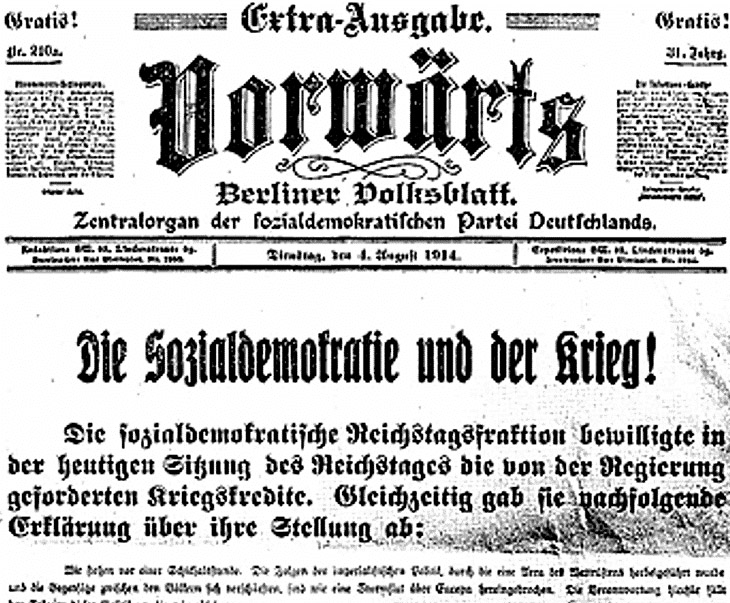
In 1914, the German Social-Democratic Party was the most powerful party of the Second International. With more than one million members, it was the largest single political party in Europe and the largest party in any European parliament. Socialists throughout the world, faced with the threat of war in the last days before that fateful 4th August, waited for the SPD to live up to its solemn commitments made at the International's congresses at Stuttgart and Basel, and oppose the war. Yet on 4th August, the SPD parliamentary fraction voted for the Imperial government's war credits, and the way to war was open.

How the German Party degenerated in the years leading up to 1914 to the point where it betrayed its most fundamental principles, and the struggle of the left in the party against this degeneration, is the subject of the article that follows.

  • Read more about 1914: how German socialism came to betray the workers

How the working class brought an end to World War I

Betrayed by its organisations, the unions and the socialist parties, the working class was unable to prevent the outbreak of the most terrible war in history. Today, the celebration of Armistice Day - the end of the war - is the occasion for patriotic celebration. 

But what was it that really brought the war to an end? Only a few years after the disaster of 1914, the world working class launched the greatest ever attempt by the exploited masses to overthrow the domination of the exploiters and to build, on the ruins of war, a new society free of nations, and warfare. In doing so, the workers forced the ruling classes to put an end to the war.

This documentary tells that story.

  • Read more about How the working class brought an end to World War I

1914: how the bloodletting began

Image removed.100 years ago, humanity stood on the brink of the abyss, about to plunge into the most terrible bloodletting ever seen in history. For generations after the Great War, 1914-18 was synonymous with senseless murder, a ghastly waste of life in the horror of the trenches, for which the suffering populations rendered the governments and the ruling classes largely responsible. To commemorate the war, one hundred years on, is thus something of an embarassment for those same ruling classes, and so 2014 became a year, not of commemoration but of forgetting.

Read more

  • Read more about 1914: how the bloodletting began

Women's condition in the 21st century

Image removed.What the socialists of the 19th century called "the woman question" remains posed to this day: how to create a society where women no longer suffer from this particular oppression? And what should be the attitude of communist revolutionaries towards "women's struggles"?

  • Read more about Women's condition in the 21st century

Decadence of capitalism (vii): Rosa Luxemburg and the limits to capitalist expansion

As we saw in the last article in this series, the central target of the revisionist attack on the revolutionary core of marxism was the latter's theory of the inevitable decline of capitalism, resulting from the irresolvable contradictions built into its relations of production. Eduard Bernstein's brand of revisionism, which Rosa Luxemburg refuted so lucidly in Social Reform or Revolution, was to a large extent based on a series of empirical observations derived from the unprecedented period of expansion and prosperity the most powerful capitalist nations lived through in the last decades of the 19th century.

  • Read more about Decadence of capitalism (vii): Rosa Luxemburg and the limits to capitalist expansion

The Free Association of German Trade Unions (FVdG) on the road to revolutionary syndicalism

In the first part of this article looked at the controversy within the German trade union movement and the SPD (Social Democratic Party) that led to the creation of the Free Association of German Trade Unions (Freie Vereinigung Deutscher Gewerkschaften, FVDG), the organization that would be the precursor of German revolutionary syndicalism.
  • Read more about The Free Association of German Trade Unions (FVdG) on the road to revolutionary syndicalism
Pagination
  • Page 1
  • Next page ››
Subscribe to Rosa Luxemburg
Home
International Communist Current
Workers of the world, unite!

Footer menu

  • Basic positions of the ICC
  • Contact