Germany 1918-19

Germany 1918: Formation of the party, absence of the International

Submitted by InternationalReview on October 6, 2008 - 20:37.
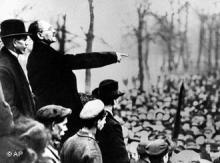
Karl Liebknecht speaks

When World War I broke out, the socialists met on 4th August 1914 to engage the struggle for internationalism and against the war: there were seven of them in Rosa Luxemburg's apartment. This reminiscence, which reminds us that the ability to swim against the current is one of the most important of revolutionary qualities, should not lead us to conclude that the role of the proletarian party was peripheral to the events which shook the world at that time. The contrary was the case, as we have tried to show in the first two articles of this series to commemorate the 90th anniversary of the revolutionary struggles in Germany.

Germany 1918 - 19, Part 2: From war to revolution

Submitted by InternationalReview on August 25, 2008 - 19:15.
In the first part of this series, published to mark the 90th anniversary of the proletarian revolutionary attempt in Germany, we examined the world historic context within which the revolution unfolded. This context was the catastrophe of World War I, and the failure of the working class and its political leadership to prevent its outbreak.

Germany 1918 - 19, Part 1: Faced with the war, the revolutionary proletariat renews its internationalist principles

Submitted by InternationalReview on June 14, 2008 - 16:59.
It is 90 years since the proletarian revolution reached its tragic culmination point with the struggles of 1918 and 1919 in Germany. After the heroic seizure of power by the Russian proletariat in October 1917, the central battlefield of the world revolution shifted to Germany. There, the decisive struggle was waged and lost. The world bourgeoisie has always wanted to sink these events into historical oblivion. To the extent that it cannot deny that struggles took place, it pretends that they only aimed at "peace" and "democracy" - at the blissful conditions presently reigning in capitalist Germany. The goal of the series of articles we are beginning here is to show that the revolutionary movement in Germany brought the bourgeoisie in the central country of European capitalism close to the brink of the loss of its class rule. Despite its defeat, the revolution in Germany, like that in Russia, is an encouragement to us today. It reminds us that it is not only necessary but possible to topple the rule of world capitalism.