Class struggle

Brazil: Police repression provokes the anger of youth

Demonstrations in Brazil

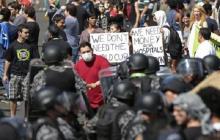
A wave of protests against the increase in public transport fares is currently unfolding in the big cities of Brazil, particularly in the Sāo Paulo, but it’s also been happening in Rio de Janeiro, Porto Alegre, Goiânia, Aracaju and Natal. This mobilisation has brought together young people in particular, students and school pupils, and to a lesser extent but still very significantly, wage workers and people on benefits, all fighting against the increases in what is already a poor quality and overpriced service, and which will add to the decline in living standards for huge layers of the population.

Why is it so difficult to struggle, and how can we overcome these difficulties?

At first sight, everything seems to favour an explosion of working class anger. The crisis is obvious and no one can escape it. Less and people believe that it’s coming to an end despite the daily assertions to the contrary. The whole planet seems to be in a desolate state: wars, barbarism, famine, epidemics, the devastating manipulation of nature and our health in the name of profit.

Spain, Greece, Portugal, Italy...growing anger about the crisis

No to austerity-Portugal

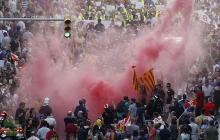
The last week of September has seen rising anger in a number of European countries in response to the brutality of the attacks and the endless succession of austerity plans. Despite the growing anger, expressed by increasingly regular confrontations with the police, the official ‘days of action’ have proved to be useless. For decades we have seen that this kind of ‘action’ serves as a means of sterilising and containing the class struggle, lining us up behind union banners, dividing us up into different sectors, trapping us between police lines and union loudspeakers which prevent any real discussion.

South Africa massacre of miners: The bourgeoisie uses its police and union guard dogs against the working class

South Africa

On 16 August, above the mines of Marikana, north west of Johannesburg, 34 people were killed by the bullets of the South African police, who also wounded 78 others. Immediately, the unbearable images of these summary executions went around the world. But, as always, the bourgeoisie and its media tried to distort the class character of this strike, reducing it to a sordid war between the two main unions in the mining sector, and bringing up the ghosts of apartheid.

Discuss with the ICC and others on our online forum

We are publishing here an extract from a post on the ICC discussion forum on the subject of intervention during a class struggle.

Massive mobilisations in Spain, Mexico, Italy, India: The union barrier against self-organisation and unification of struggles

While governments of every country are bent on imposing more and more violent austerity plans, the mobilisations of 2011 – the movement of the Indignant in Spain, Greece, etc., and the occupations in the United States and other countries – continued during the first quarter of 2012. However, the struggles came up against a powerful union mobilisation that managed to seriously hold back the process of self-organisation and unification, which began in 2011. How do we get out from under the unions’ thumb? How do we once again find and revive the tendencies that appeared in 2011? We are going to try to give some elements of a response to these questions.

Class Tensions in Canada

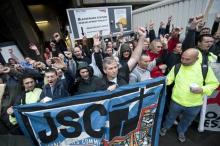
It has now been just over one year since the Conservative Party won a majority government in the last federal election.Since then Canada has been hit by a veritable wave of working class struggles and social unrest over the past year. Beginning in the summer of 2011, with tensions at Air Canada and the Canada Post strike and lockout.
Oil tanker drivers’ struggle: Bourgeois campaigns obscure the needs of the struggle

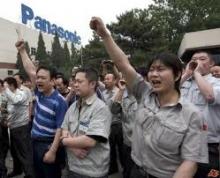
The furore over the oil tankers’ dispute shows what workers are up against in today’s capitalist system. The workers are fed up with the working conditions imposed on them by the oil companies and the contracting agents they use to hire them. They frequently have to work extremely long hours, which is a dire threat not only to their own safety but the safety of many others given the volatile nature of their cargo. There have also been serious attempts to cut their wages.

Class struggle the only alternative to austerity and massacres

In January a six day general strike in Nigeria was one of the most extensive social movements ever to hit the country. Only 7 million are in unions but up to 10 million took part in the strike, right across Nigeria, with demonstrations in every major city involving tens of thousands overall. The strike was part of a protest against the abolition of fuel subsidies which overnight doubled the cost of not only petrol but also had a similarly massive impact on food, heating and transportation costs.

Capitalism is bankrupt: We need to overthrow it

Unemployed

There was a time, not so long ago, when revolutionaries were greeted with scepticism or mockery when they argued that the capitalism system was heading towards catastrophe. Today, it’s the fiercest partisans of capitalism who are saying the same thing. It’s not with any joy in their hearts that these defenders of capitalism are admitting that their idol is on the way out. They are obviously shattered by this, all the more so because they can see that the solutions being put forward to save the system are unrealistic. As the journalist reporting Jean-Pierre Mustier’s words put it: “as for solutions, the cupboard is bare”. And with good reason!

Economic depression, war, social decay: Only the class struggle offers a way out

Not dead yet

The dramatic worsening of the world economic crisis over the summer gives us a clear indication that the capitalist system really is on its last legs. The ‘debt crisis’ has demonstrated the literal bankruptcy not only of the banks, but of entire states; and not only the states of weak economies like Greece or Portugal but key countries of the Eurozone and on top of it all, the most powerful economy in the world: the USA.

Solidarity with Striking Verizon workers!

For the first time in 11 years, 45,000 Verizon workers across the Mid-Atlantic region have returned to the class struggle, courageously refusing to submit to the bosses’ logic of making the working class pay for the deepening economic crisis of capitalism!  Our exploiters say we should sacrifice to help the economy get going again, or to support the profitability of a company in order to safeguard jobs. But the latest draconian assault on pension benefits is proof that the more workers give in, the longer they delay their response to the boss’s attacks, the more emboldened and brutal the next round of attacks will be.

Special Report on the 15M movement in Spain - Updated July 7th

The social movement that has swept Spain since mid-May is of historical significance. The poor and the working class, especially its youth, are now reacting to the massive onslaught brought on by the economic crisis. But even more than the immense anger being manifested, it's the organisation of the struggle in general assemblies and the reflection that drives the debates that demonstrate a real advance for the struggles of our class. That is why the bourgeoisie, with an iron fist, have ochestrated an incredible media blackout on an international scale. Information about what is really happening on the streets of Madrid, Barcelona, Terrassa isn't filtering out. This collection of articles therefore intends to contribute to breaking this silence. We will try to update it as often as possible with translations of articles, videos and eye-witness reports.

Solidarity with the “indignant” in Spain: The future belongs to the working class!

This article has already been published on our site here.

Solidarity with the "indignant" in Spain: The future belongs to the working class!

While the media has been full of Obama’s ‘triumphant’ visit to Europe, or the scandal about Dominique Strauss-Khan, they have not told us much about the real earthquake hitting Europe: a vast social movement which is centred in Spain but which is having an immediate echo in Greece and threatens to break out in other countries as well.

Militant workers' meeting in Alicante, Spain

Our comrades in the Alicante Encounter and Solidarity Network (Red de Encuentro y Solidaridad) and in the L'Escletxa collective organised a meeting to discuss and support the workers' struggle on 11th and 12th February. They examined the experience of the struggles in France and Barcelona. The declared aim of this meeting was: “To work together for the development of the class struggle”.

What can we learn from the blockade of the oil refineries in France?

We are publishing here an article written by our French section in Revolution Internationale 420 in response to the very widespread debate about the tactic of the oil refinery blockades during last autumn’s struggles against pension ‘reforms’.

France, Britain, Tunisia: The future lies in the international development of the class struggle

The strikes and demonstrations of September, October and November in France, which took place following the reform of pensions, demonstrated a real fighting spirit in the ranks of the proletariat, even if they didn’t succeed in pushing back the attacks of the bourgeoisie. This movement is taking place in the context of a renewed dynamic of our class as it gradually returns to the path of struggle internationally, following a course marked in 2009 and 2010 by the revolt of new generations of proletarians fighting poverty in Greece and by the determination of the Tekel workers in Turkey to extend their struggle against the sabotage of the unions.

The bourgeoisie fears the contagion of revolt


Revolt is contagious, above all when more and more of the world’s population are facing a future of misery thanks to the deepening of capitalism’s economic crisis. The ruling class has no real control over the crisis and is becoming increasingly concerned about the growth of resistance to its austerity plans. This concern is manifested in two ways: the attempt to make concessions and ‘democratise’ its rule, coupled with the strengthening of its whole apparatus of repression.

The Importance of the Workers Struggles in Egypt

The article below was written in mid-February, during a wave of workers’ strikes which spread to numerous sectors. Although the governing military responded with stern warnings to the strikers,many of their demands were quickly acceded, thus avoiding a head-on confrontation. The strike wave seems now to have abated, but the Egyptian working class has kept its fighting spirit intact.Furthermore, as the article emphasises, the tendency towards the mass strike, which can certainly be discerned in this recent movement, unfolds on a historic scale, so that particular expressions of it contribute to the development of much deeper and wider movements in the future.

Our alternative:resist the capitalist regime!

Egyptian Protesters

When we are taking part in demonstrations, whether local rallies or big national marches, let’s use them to make links between different centres of resistance, different sectors of the working class. Let’s organise our own street meetings where instead of listening to celebrity speakers we can freely exchange experiences from our own struggles and prepare for the battles of the future. Let all those who stand for independent, self-organised workers’ struggles use them as an opportunity to meet up and decide on how to connect to wider numbers of their class.

Wisconsin Public Employees: Defense of the Unions Leads to Defeat

Tens of thousands of public sector workers and students have taken to the streets and are occupying the state capitol in Wisconsin to protest proposed changes to collective bargaining agreements between the state government and its public employee unions. The state’s rookie governor, Tea Party backed Republican Scott Walker, has proposed a bill removing collective bargaining rights for the majority of the state's 175,000 public employees, effectively prohibiting them from negotiating pension and health care contributions, leaving only the right to bargain over salaries.

Egypt: The class struggle takes centre stage

The tide of rebellion in North Africa and the Middle East shows no sign of abating. The latest developments: demonstrations and clashes with the police in the Libyan city of Benghazi following the arrest of a lawyer involved in a campaign demanding an investigation into the brutal massacre of hundreds of prisoners after a protest in 1996. Qaddafi’s regime again displays its ruthless brutality – there are reports of snipers and helicopters firing into crowds, killing many; in Bahrain, thousands of demonstrators occupy the Pearl Roundabout in Manama, hoping to emulate the occupation of Tahrir Square. They raise slogans against sectarian divisions (“No Shia, no Sunni, only Bahraini”) and against self-appointed leaders (“We have no leaders”). At the time of writing, riot police have now cleared the area with considerable violence – many demonstrators have been injured and some killed. In Iraq, there have been new demonstrations against the price of necessities and the lack of electricity. 

Revolts in Egypt and the Arab states: The spectre of the development of the class struggle

At the time of writing, the social situation in Egypt remains explosive. Millions of people have been on the streets, braving the curfew, the state regime and its bloody repression. At the same time the social movement in Tunisia has not gone away: the flight of Ben Ali, the government reshuffle and the promise of elections has not succeeded in damping down the deep anger of the population. In Jordan thousands of demonstrators have expressed their discontent with growing poverty. In Algeria the protests seems to have been stifled but there is a powerful international black-out and it seems that there are still struggles going on in Kabylia.

Campaigns about the fall of Ben Ali in Tunisia: how the media serves the ‘democratic’ bourgeoisie

For weeks, all the democratic states, with France at their head, have been supporting Ben Ali’s blood-soaked regime. There was an almost total black-out of information even though all these governments knew exactly what was happening in Tunisia. All the bourgeois media justified this disinformation by letting on that the country was experiencing riots but was in a confused, chaotic situation which was very difficult to understand.

Bloody repression in Tunisia and Algeria: the bourgeoisie is a class of assassins!

For several weeks now we’ve seen an uprising in Tunisia against the misery and unemployment which is particularly hitting the young. All over the country, street demonstrations, meetings, strikes have spontaneously broken out protesting against the regime of Ben Ali. The protestors are demanding bread, work for the young and the right to live in dignity. Faced with this revolt of the exploited and youth deprived of a future, the dominant class has responded with a hail of bullets.

International Situation

Student/worker demonstrations: We need to control our own struggles!

The leaflet below was given out at the large meeting held at King's College on Monday 15th November, under the auspices of the left wing of the unions (Education Activists Network). We would welcome comments, criticisms, and above all, offers to distribute it or improve and update it in this period leading up to next week's Day of Action. A comrade from the ICC's section in Toulouse, which has been very active in the movement for struggle committees and assemblies,  was able to speak at the meeting; and despite a frontal attack on the French union strategies, was widely applauded. We will try to piece together more elements about this meeting.

What lessons can we draw from the Madrid Metro workers strike?

We are publishing a statement written by the comrades of the CREE (Coletivo Revolucionario Espartaquista Estudiantil) about the Madrid Metro workers’ strike at the end of June, in response to wage cuts and tax increases imposed by the local authority.

Panama: Struggles of banana workers

Various comrades and groups have sent us information and comments on this struggle that took place recently. We are deeply grateful to them for their collaboration and encourage them to continue. We all know that the media is not neutral and shamelessly serves its masters, the state and capital, sometimes implementing a total black-out on workers' struggles - particularly those that show clear tendencies towards solidarity, self –organisation and militancy...

Syndicate content