


Submitted by ICConline on

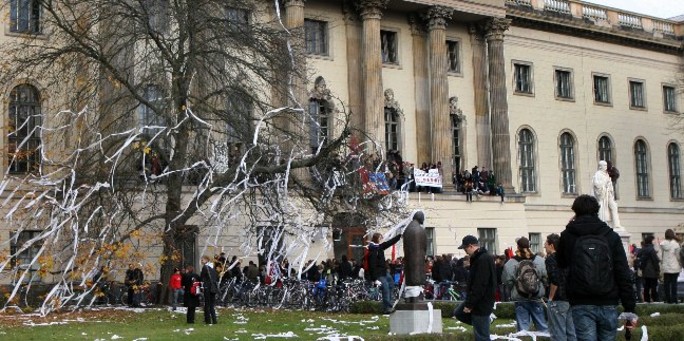
On Wednesday the 12th of November 120.000 school kids took to the streets in Berlin, Cologne, Hannover, Munich, Trier and many other German cities. They protested against increasing examination stress, the shortage of teachers, the resulting cancelling of lessons etc. In other words, they protested against the intolerable conditions in the schools. Their protest threw the light of truth on the grand speeches of politicians about how much they value education; on the different "educational offensives" they announce in response to the miserable "marks" their system has been given in the "Pisa" quality assessments, where they pose unceasingly with the kids in front of the camera. The school school students have brought to the fore the best qualities which characterise this young generation: The radicalism of their criticism, their lack of respect for the hallowed institutions of the ruling class, the audacity of their actions.
You can find enough shortcomings of these protests if you want. The party atmosphere of the demonstrations has been pointed to, or the fact that the sparks of insubordination only rarely spread to the teachers and students. You can complain that this movement did not organise itself, that the protests were called by official and semi official pupil representation structures or private initiatives such as "Break Through the Education Blockage". But all such grumbling misses the essential point of these protests, which are far from being a mere footnote of the class struggle.
These actions are part and parcel of the struggles of the working class as a whole, not least of the international protest movement of contemporary school students and students, which began with the protest movements of these sectors against the "CPE" legislation in France in the spring of 2006. France and Chile 2006, Italy and Spain in the autumn of 2008, and now Germany as well. Everywhere the young generation is returning to the scene of struggle against the worsening of the living, working and learning conditions. It is even placing itself in the forefront of the workers' struggle.
It is striking that, in all of these movements the school students have played a particularly active role. In Germany the school students have even assumed a vanguard role. They were the driving force behind the protests, and not the students, among whom to a great extent passivity had crept in. The latter had worn themselves out in recent years in the aftermath of protests against the introduction of university fees, which, under the direction of leftist groups, dispersed themselves in activism and boycott actions.
What is also striking is the grim determination with which the protesting school students expressed their indignation. Two episodes express this powerfully. In Berlin, thousands of school students briefly occupied the venerable Humboldt University, hanging flags and slogans out the windows such as: "Capitalism is the crisis".
What happened in Hannover was even more spectacular. There, the protests broke through the police ban mile around the provincial parliament of Lower Saxony, besieged the "holy house of democracy" and even tried to storm it. This resulted in scuffles with the uniformed representatives of the state, in the course of which some of the school students made the unpleasant acquaintance of state repression.
It is enough to imagine that the workers of the nearby Volkswagen plants might follow this example in order to begin to sense the explosive potential of such proceedings. As far as we are aware, this is the first time in the post war German Federal Republic that the working class undertook such an action. It was left to the school students of Hannover - as wage labourers of the future, part of the working class - to be the first to directly attack the parliament as the symbol of domination in western capitalism, without bothering in the least about the unspeakable character of this breaking of taboo's in the eyes of the ruling class. Congratulations!
Indeed, the present world wide movements of school students and students distinguish themselves from their predecessors in the 1960's and 1970's through the progressive loss of illusions in relation to bourgeois mystifications, through their soberness regarding the system and its perspectives. What is at issue today is no longer having your own pupil representation, but basics of life, concrete material demands which capitalism is less and less able to fulfil. The advanced stage of the crisis is lending the present pupil and student actions a much more radical character than that of the 1960s and 70s.
The present youth movements also distinguish themselves from the "no future" generation of the 1980s. Already the simple fact that the present generation increasingly defends itself collectively, that it raises concrete demands, is a sign of anything but resignation. Those who struggle have not yet lost hope for the future.
Weltrevolution 26.11.2008
 del.icio.us
 Digg
Digg Newskicks
 Ping This!
 Favorite on Technorati
 Blinklist
 Furl
Furl Mister Wong
 Mixx
Mixx Newsvine
 StumbleUpon
 Viadeo
 Icerocket
 Yahoo
Yahoo identi.ca
 Google+
 Reddit
 SlashDot
 Twitter
 Box
Box Diigo
Diigo Facebook
 Google
 LinkedIn
 MySpace